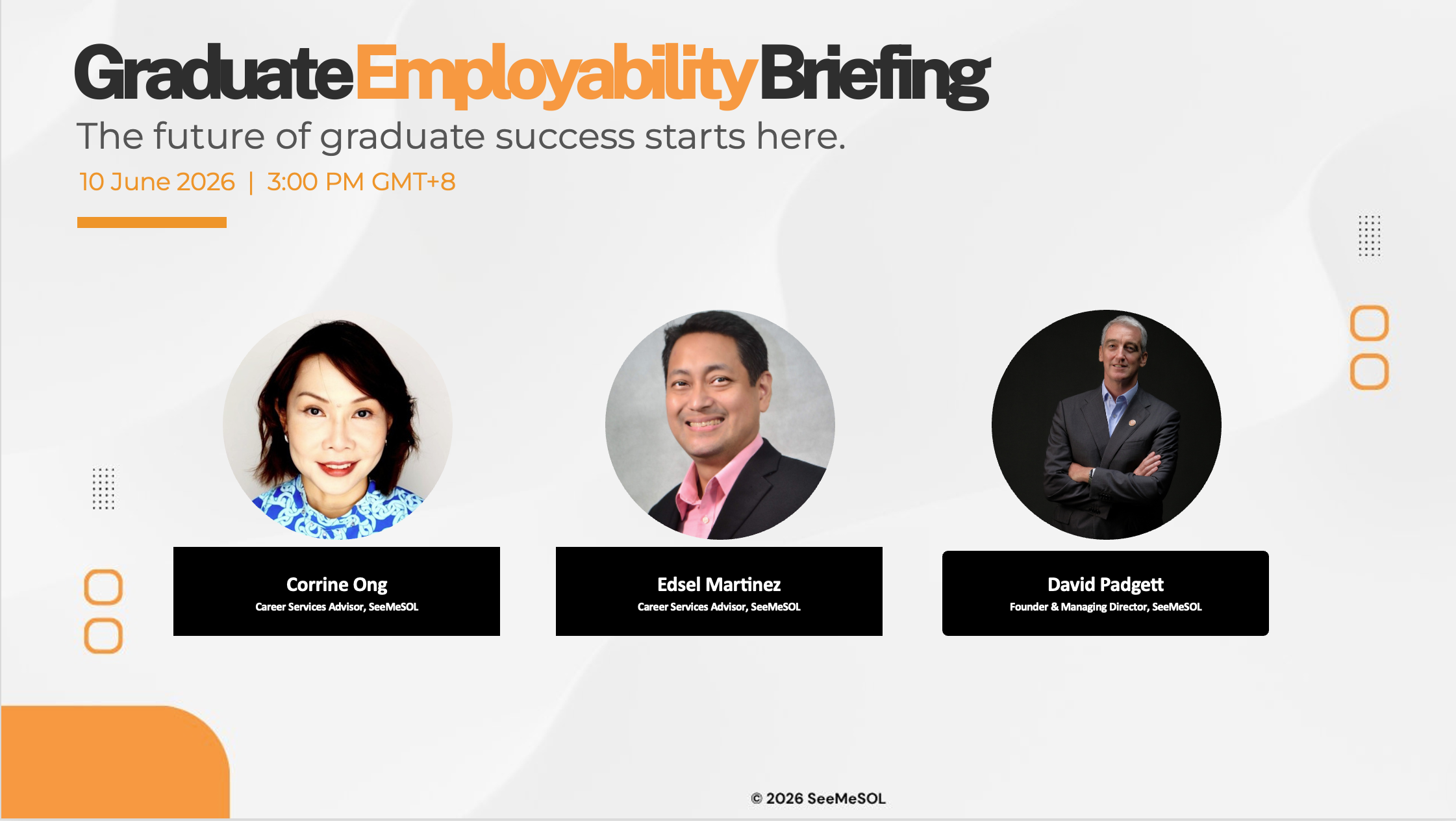
SeeMeSol Graduate Employability Briefing | 10 June 2026 | ASEAN
On 10 June 2026, SeeMeSol hosted its first regional online briefing on graduate employability — drawing nearly 200 registrations from careers services professionals, institutional leaders and practitioners across 12 countries. The room included universities and colleges from the Philippines, Vietnam, Singapore, Brunei, South Africa, Egypt, Australia and beyond.
What followed was one of the most honest conversations we have had about a challenge that is defining higher education right now: the widening gap between what institutions produce and what employers need — and what careers services teams can actually do about it.
The context: a system under real pressure
Careers services has transformed. What was once a student guidance function bolted onto the end of a degree programme is now expected to demonstrate graduate outcomes, engage employers, mobilise alumni, and contribute to institutional rankings — with teams and technology that, in many cases, have not kept pace with those expectations.
Our panel brought that reality into the room. Corrine Ong has spent her career in talent management and careers services, including driving a major university’s QS employer reputation ranking up by 76 places through structured alumni engagement. Edsel Martinez works across Philippine higher education and sees daily the gap between what institutions aspire to and what they can operationally deliver. Together, they gave our 200 attendees both the strategic framework and the on-the-ground honesty this conversation needs.
What the data shows: the MARA lens
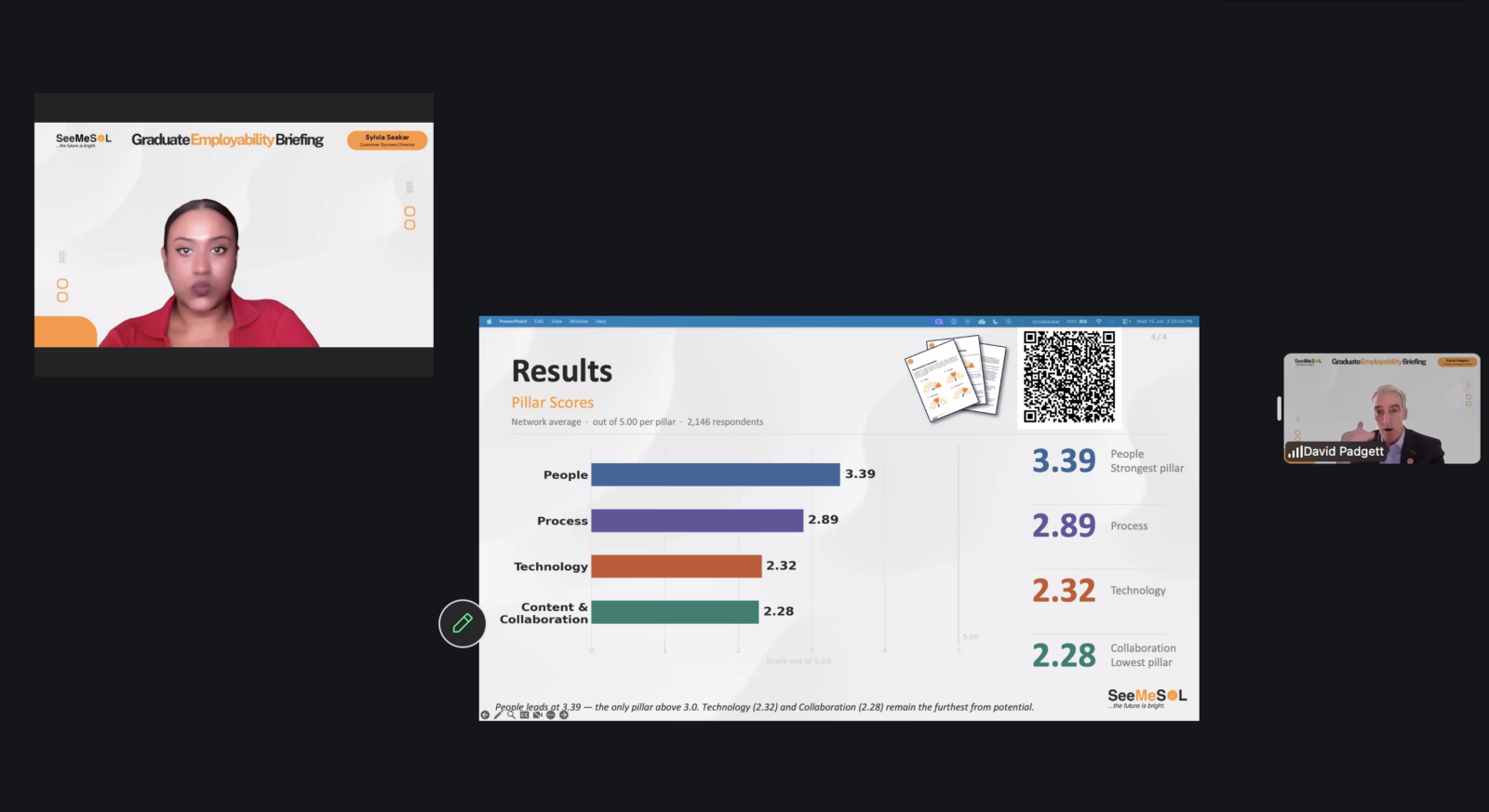
Before the discussion, we shared findings from SeeMeSol’s Maturity and Readiness Assessment — MARA — which has now gathered over 2,000 survey responses across 27 countries, assessing careers services maturity across four dimensions:
- People — team skills, capacity and development
- Process — how services are designed, run and measured
- Technology — the tools, platforms and data infrastructure in use
- Content & Collaboration — employer relationships, alumni engagement and industry partnerships
The global average score is 2.7 out of 5. Institutions tend to score highest on People and Process — committed teams with reasonable structures — but consistently fall short on Technology and Content & Collaboration.
Then we asked our live audience: where is your careers service weakest?
- 36% said Content & Collaboration — building employer and alumni partnerships — is their weakest area
- 30% said Technology
- 21% said Process
- 13% said People
The room’s answer matched our global research exactly. Content & Collaboration — the dimension most directly linked to graduate outcomes — is where institutions are most exposed. Corrine captured the implication precisely: the four pillars are interconnected. Technology doesn’t replace people — it frees them to focus on what matters: student engagement, employer relationships, and the conversations that move graduate outcomes.
Careers Services 2.0: from reactive to strategic
Edsel outlined four shifts that define the transition to what he calls Careers Services 2.0:
- Measuring career readiness before graduation, not just after
- Structuring employer engagement rather than managing it ad hoc
- Implementing continuous graduate tracking — not just point-in-time tracer studies
- Using careers services data to inform institutional leadership decisions
The institutions making this shift are not necessarily the best resourced. They are the most intentional — and they are pulling ahead on the metrics that matter.
We asked the room how ready they feel for this transition:
- 78% said they are “Mixed” — some progress, but real gaps remain
- 10% said they are Largely ready
- 9% said they are Behind where they need to be
- 3% said they are Fully ready and leading
- 0% said they are Not ready and worried about it
The 78% mixed result is nuanced and important. The room is not in crisis — no one said they were worried and unready. But the honest majority acknowledge they are mid-transition, with ground still to cover. Only 13% are at the leading edge. That gap represents both a challenge and a very large opportunity.
Rankings: the pressure is now official
The urgency of this transition is no longer just aspirational. How institutions are judged is changing structurally.
In the QS World University Rankings, 20% of an institution’s total score now comes from the Employability & Outcomes lens: 15% for employer reputation and 5% for employment outcomes. That is the same weighting as research citations — a metric institutions have invested in for decades.
Corrine’s institution improved its QS employer reputation ranking by 76 places through deliberate, structured alumni engagement. Not through a marketing campaign, or a new building, or a curriculum overhaul. Through connecting alumni back to the institution in a way that made employers notice.
Beyond formal rankings, Edsel noted that the shift is also being felt in admissions. Students and parents in the Philippines — and across ASEAN — are asking practical questions earlier: What is your graduate employment rate? Do you have industry connections? What careers support will I receive? These are no longer post-enrolment concerns. They are deciding factors.
The alumni opportunity: the most underused asset in higher education
One theme emerged consistently across every part of the session: alumni.
Where universities run structured alumni programmes, 76% of alumni mentor current students. Alumni bring industry connections, hiring authority, coaching capacity and institutional advocacy — yet most institutions still engage them primarily around fundraising, events and the occasional tracer study.
- 54% of our attendees rated their institution’s alumni engagement as Average — events and giving, not much more
- 18% rated it as Weak
- 4% rated it as Very weak
That means 76% of the room — more than three quarters — are not mobilising their alumni as a strategic asset for graduate outcomes. The asset exists. The motivation to engage exists. What is missing is the system and strategy to activate it.
David Padgett framed it directly: alumni have the financial means, the industry connections and the motivation to help their institution and its students. The question is whether institutions have the infrastructure to mobilise them at scale — and whether leadership treats alumni engagement as a graduate outcomes strategy, not just a fundraising function.
AI and the changing employment landscape
The session closed with a conversation that many in the room clearly needed to have: what does AI mean for graduate employment, and for careers services itself?
Corrine raised a real concern: AI is beginning to replace entry-level and intern positions — the very roles that have historically given graduates the work experience that makes them employable. If internships and early roles are displaced by automation, the pathway from education to meaningful employment narrows for an entire generation.
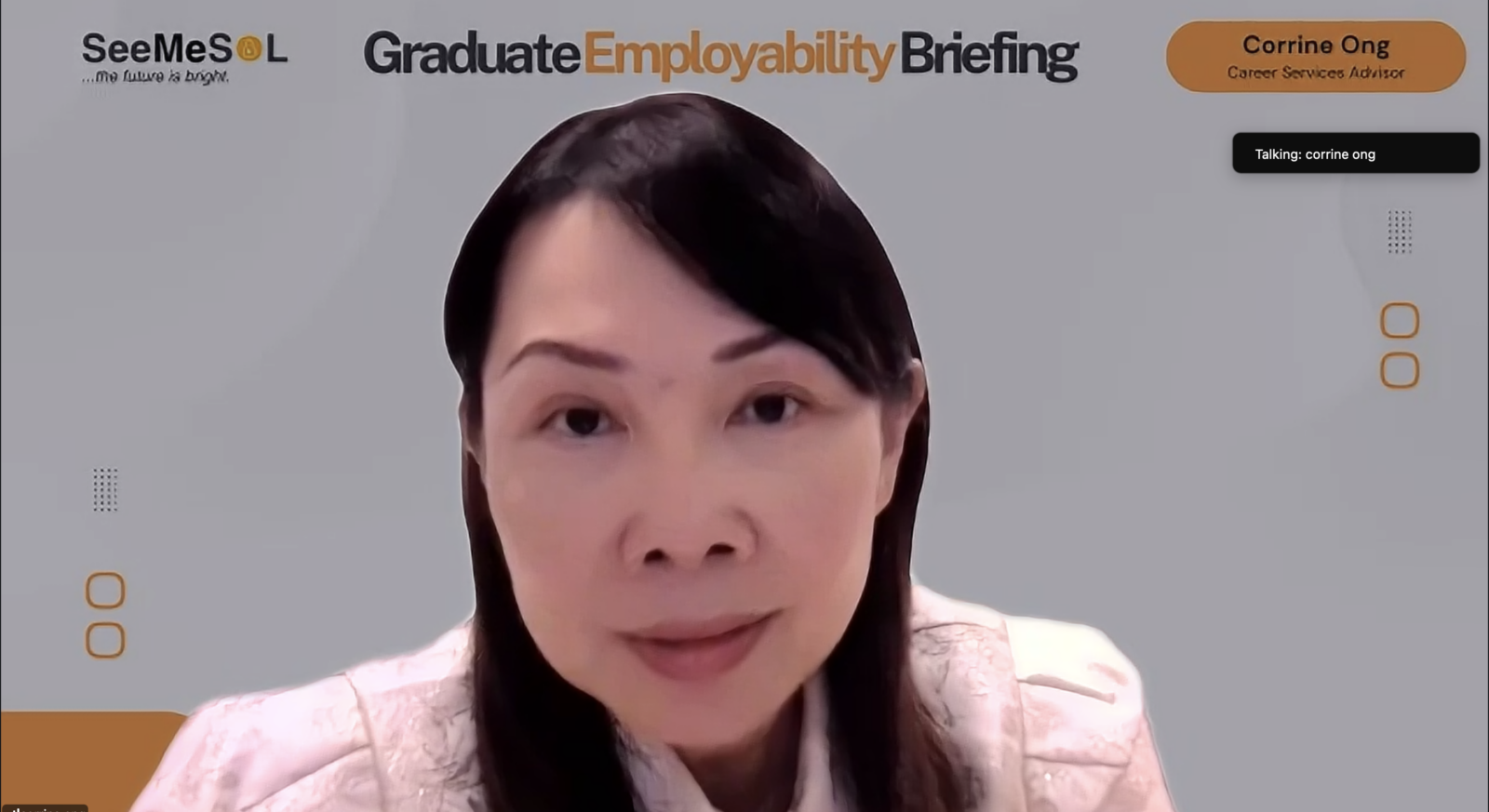
The panel’s consensus was not to resist AI but to integrate it — into curricula, into careers services tools, and into the mindset of students who need to develop both human skills and digital fluency to remain competitive. Edsel emphasised the importance of combining AI literacy with the allied and interpersonal skills that automation cannot easily replicate. Corrine encouraged institutions to help students see AI as an entrepreneurial opportunity, not just a threat.
What the room wants next
We closed with a live poll asking attendees what would be most useful after the session. With 51 respondents and multiple selections allowed, the results were clear:
- 75% want help re-engaging and growing their alumni community
- 69% want help building or strengthening their careers service
- 51% want help setting up a careers services portal for their students
- 39% want help running a virtual or hybrid career fair
- 31% just want the recording and resources for now
Alumni re-engagement was the single most-requested next step — reinforcing exactly what the session surfaced: the asset is there, the intent is there, and the gap is in activation.
What’s next
SeeMeSol is building on this session in two ways.
First, we are launching a regional community of careers services professionals across ASEAN in July 2026 — a peer network for the practitioners in that room and beyond to share data, challenge each other and collectively raise the standard of graduate outcomes across the region.
Second, the next cohort of our Career Services Foundation Certification programme begins in July/August 2026, run by Edsel Martinez. It is a structured five-module programme designed to give careers services professionals the frameworks, tools and confidence to operate at a more strategic level.
If you work in careers services, alumni relations or institutional strategy in ASEAN and want to be part of what comes next — the community, the certification, or a conversation about how SeeMeSol can support your institution — we would welcome the connection.
The recording and full data pack from the session are available to all registrants. To access them or to speak with our team, visit seemesol.com or reach out directly.
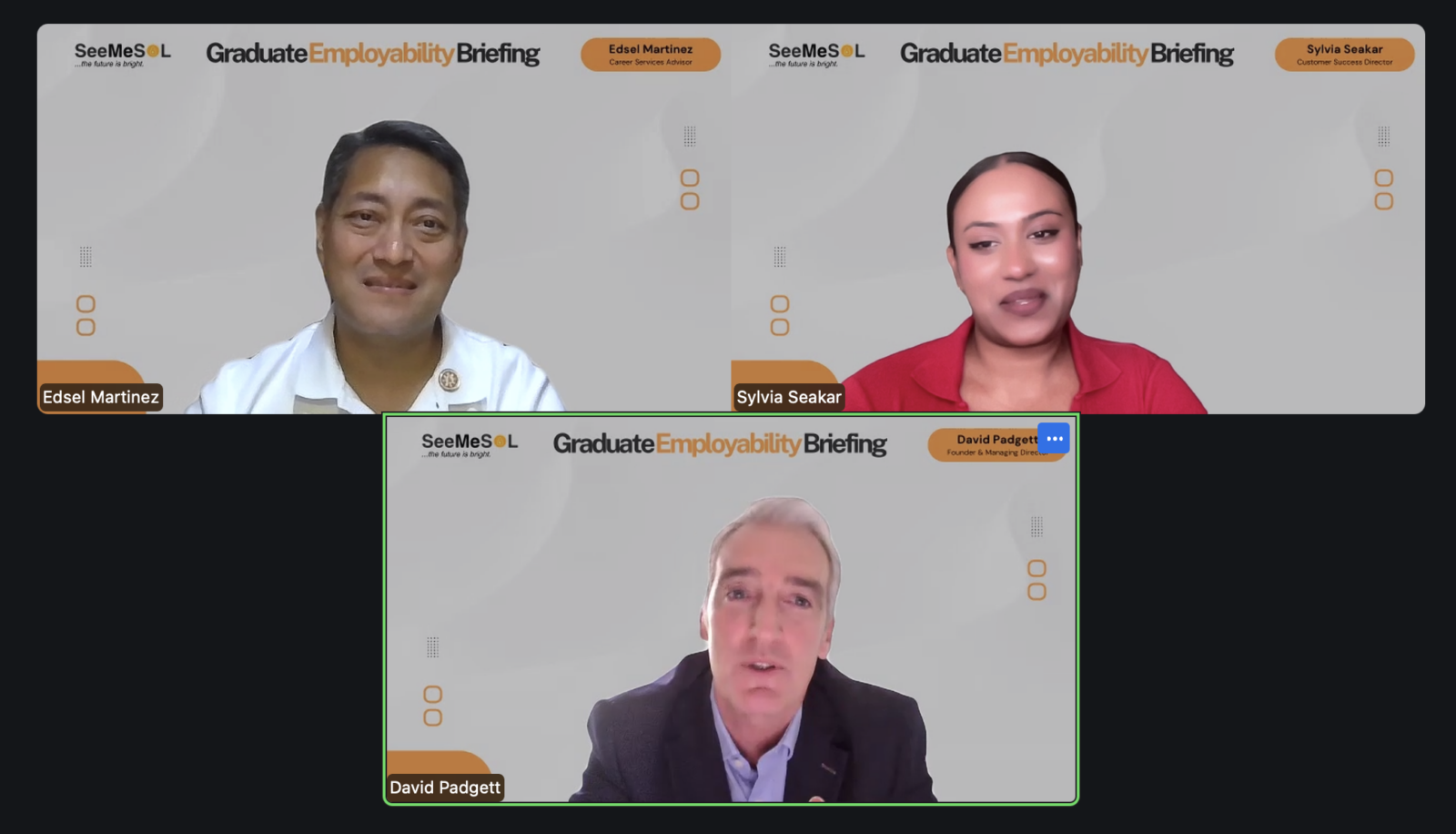
Speakers: Corrine Ong, Edsel Martinez, David Padgett | Host: Sylvia Seakar | SeeMeSol Graduate Employability Briefing, 10 June 2026
Data sources: Live Zoom poll export (n=47–59 per question); SeeMeSol MARA survey (2,000+ responses, 27 countries); QS World University Rankings methodology 2026; Vitae/IFC Alumni Engagement Strategies That Work, Jan 2026.