Most CS content talks about renewals, health scores, and churn.
This one is about something I've been sitting with after a week of conversations that reminded me why this work actually matters.
My role in CS is not what most people think it is.
Especially in Southeast Asia. Especially in the talent space.
Yes, I lead customer success. But in a region where education and employability are deeply intertwined, my role goes beyond product adoption. It's being part of the dialogue on graduate outcomes. Shaping careers, not just software usage.
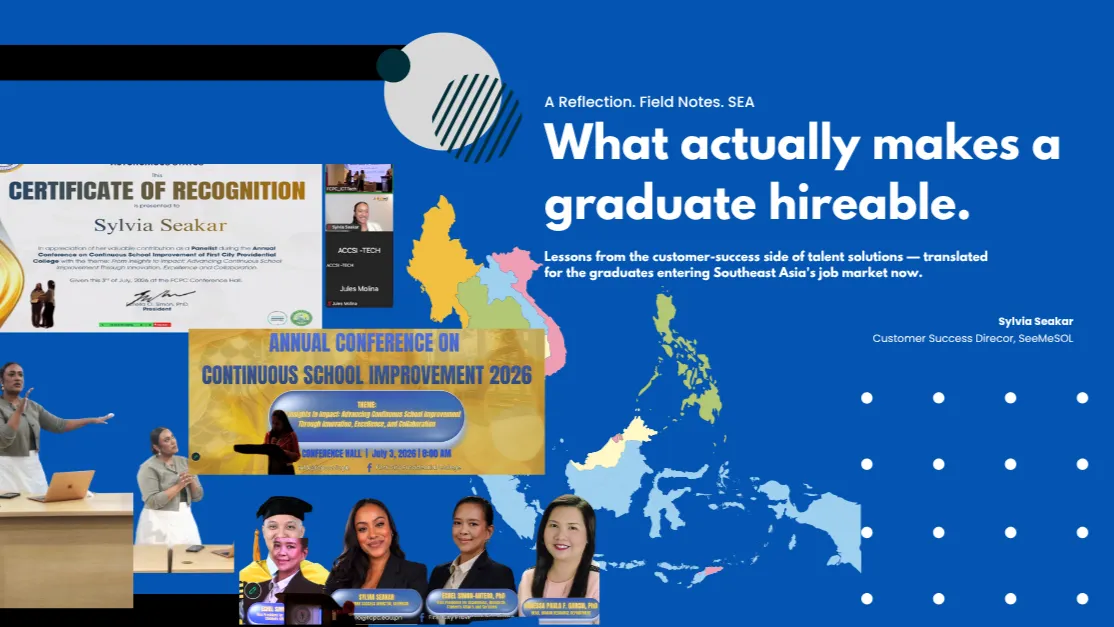
This week I had the honour of speaking at a private education institute here in Singapore, and joining a panel at the Annual Conference on Continuous School Improvement (ACCSI) 2026 with our partner in the Philippines.
Different countries. Different institutions. One shared conversation: graduate employability.
And it is a real, urgent one.
The landscape right now
Brain drain. Brain gain. Foreign students seeking opportunities in Singapore. Philippine graduates looking overseas. Singaporean graduates navigating one of the toughest hiring markets in recent memory.
Every room I was in this week was grappling with the same tension: how do we prepare students for a workforce that looks nothing like the one we designed our curricula for?
AI literacy vs AI fluency came up everywhere. And the gap between the two is where a lot of graduates are getting stuck.
Knowing AI exists is not the same as knowing how to work alongside it. Fluency means being able to use it, adapt it, and think critically about when it helps and when it doesn't. That's a skill. And right now, most graduates are leaving school with awareness, not fluency.
My hot take
Don't underestimate intentional volunteering, mentoring, and networking.
Not the transactional kind. Not the "connect with me so I can ask for a job" kind. The kind where you show up genuinely, learn from people already doing what you want to do, and build relationships before you need them.
The graduates I've seen break through in tough markets aren't always the ones with the best grades. They're the ones who stayed curious, stayed visible, and kept showing up even when nothing was happening yet.
For graduates, educators, and parents
The equation has changed.
What you studied no longer equals what you work. What matters now is what you can do — your competencies, your side projects, your ability to translate your skills into what the market actually needs.
This is not the end of the road. It's just a different map. And the students who learn to read it early will be the ones who get where they want to go.